

There is a scene in The Social Network movie that perfectly captures the mythology of the early internet. Mark Zuckerberg has just rage-launched his Facemash website on the Harvard network. Frantic energy pulsates through the sequence that follows: a montage of students across the campus opening their emails, shock and awe on their faces, friends passing word around, rhythmic clicking of computer keys as photos get rated, Harvard IT administrators staring at their monitors as the traffic graphs spike exponentially, the dean answering a 4 a.m. emergency call in his bedroom… the works.

Mark and his friends are staring at his black and green computer terminal as the website traffic numbers grow rapidly. Eduardo gets worried. He advises Mark to take down the website lest they get into trouble – a suggestion that gets nothing but a sneer from Mark. The website traffic explodes so fast that the Harvard network ends up crashing. Climax. Zuckerberg, lit by the glow of his monitor, smiles in the knowledge of having made something massive. End scene.
Granted, the sequence is largely cinematic fiction. The launch of Facemash apparently did not crash Harvard’s network. Even so, let’s humour the depiction a little further and imagine what the same sequence would look like if the movie were made today, in the era of generative AI.
It’s 2026. Mark Zuckerberg has just launched a website named Facemash from his dorm room. The website has AI in it, obviously. Perhaps it uses AI to find the most “personalised” pair of photos for each user to compare. Mark has either integrated a frontier lab’s AI model into his website using an “API”, or used an open-weight model of his own since he is, well, technical. Either way, he launches the website and watches its performance, his eyes scanning every pixel with nervousness. We see him looking at two monitors side-by-side: one shows live traffic numbers, the other a dashboard displaying the number of “tokens” being consumed by visitors.

As more people log in, one monitor carries good news, just as in the movie. The other, however, shows token usage ticking upward rapidly. The network does not crash because modern infrastructure would absorb the traffic just fine. Instead, Zuckerberg and his friends see the website traffic and the AI bill climb together, the latter faster than the former. Eduardo is not worried this time about the university authorities finding out, but about the money he will have to spend on the AI bills. The camera focuses on Zuckerberg’s face: instead of a triumphant smirk, we see the worried realisation that the only way to stop the financial bleeding is to reach over and pull the plug himself. No climax. End scene.
It makes for terrible cinema, but welcome to the AI era of software.
Easy Fox
In previous eras of software startups, a server crashing from a sudden stampede of users – what developers endearingly called the “hug of death” – was the ultimate “tech rite of passage”. The hug of death was proof that people loved what you built, and it was cheap to get that proof so long as only a few rules were broken. Today, that dynamic has turned towards a quest for “virality”. But unlike the hug of death, virality for a piece of “AI-native” software today does not guarantee validation. It guarantees immediate debt to whichever company’s API was used in the software.
An indie game studio called Easy Fox experienced this new reality when they launched a free demo of their AI game Teach My Little Sister How To Drive on Steam. The game’s concept is really fun: you sit in the passenger seat while your virtual “little sister” learns how to drive. What makes it unique is that the sister’s character does not speak in scripted dialogue. She is an AI, which means her responses and actions are personal and unique to each player. Think of it as your favourite LLM inside a virtual character that talks to you, responds to you, plays with you, and so on.
Within roughly a month, the number of players on the demo grew more than twentyfold. People were finding it, playing it, sharing it with their friends and followers. Every software creator dreams of moments like these. “Usage” is a proxy for consumer love, to see even hints of it feels like assurance that you are on the right path, that you may even be on track to make a “hit”. For Easy Fox, the love came with an invoice. Because the sister’s character is an AI, every line she spoke was generated by a model rented from the big labs – OpenAI in this case. Every interaction between a player and the character cost the studio real money. Easy Fox was incurring more than $1,000 a day in AI costs and had to take out a bank loan (!) to keep the demo running.
“We are a small team of four, and financial pressure may mean we have to close the demo earlier than expected.”
Easy Fox, in an update to players
The studio says it will factor the cost of AI into the price of the finished game, slated for a release next year. Whether the demo’s popularity converts into sales – or forces the team to ration how much AI is used inside the game – remains to be seen. The bigger story is less the fate of one game, and more a new kind of tax consumer technology businesses have to pay the frontier AI labs before they can pay themselves in this era of technocapitalism.
The Success Tax
The success tax for consumer tech companies in the AI era is quite simply this – the more people love what you build, the faster you spend, and you spend long before you know whether that love from consumers will translate into a business. This is, of course, only true for consumer products where AI is “native” to the experience, that is, involving AI features users can interact with. “Consumer AI” wouldn’t be defined any other way.
This predicament explains a lingering mystery in the technology industry: the missing “consumer wave” of AI.
You see, every major technology of the last few decades eventually produced a wave of culture-defining companies that nobody could have predicted from the technology itself: companies that took something new and strange and turned it into an experience, then a habit, then a category, then simply a part of ordinary life. Facebook was born in a world where broadband, cheap servers, and free open-source software made it possible for a student to build a social network from his dorm room. The web filled up with social networks, video sites, and blogs, mostly built by people who had nothing to do with inventing the internet. A few years later, the smartphone and its app store gave us Instagram, Uber, WhatsApp and a long tail of smaller apps.
In those eras, the inventors would lay the groundwork by establishing new technology as infrastructure, then a much larger crowd of developers would take the technology into people’s lives through apps and experiences. It is perhaps why, in retrospect, technology has influenced consumer culture in waves: the social-network wave, the mobile-app wave, the creator economy wave, etc.
AI is arguably a larger technology shift than any we have seen before, yet the front row of consumer AI is still occupied almost entirely by the companies that made the models in the first place – ChatGPT, Claude, Gemini, and so on. Why?
One possibility is that the majority of AI isn’t groundwork to build upon, but is instead itself a product that a handful of companies make and sell to us directly. That would explain the absence of a wider consumer wave. After all, products don’t create waves, they create customers.
Or what if we are waiting for a mystical consumer AI wave when the big consumer AI moment has already happened? After all, a billion people use AI across different products and platforms. I hope not, because if so, then the AI “frontier” was never a frontier to something greater, it was the whole damn show.
But if we believe AI is in fact a foundational technology upon which massive companies are yet to be built, and the culprit isn’t a lack of talent, ideas, or consumer demand, then the reason is more structural: the “AI internet” as it stands today may simply not be designed to facilitate a consumer AI wave.
Structurally Unfriendly
In the Web 2.0 and mobile eras, infrastructure was a structural advantage. When Zuckerberg built Facebook, or Kevin Systrom built Instagram, the marginal cost of the core interactions inside their apps was low. They could afford to let people log into their apps, play, waste time, and form habits for free. That kind of frictionless exploration is essential for consumer platforms to grow. The playbook was to build a great playground, let people in for free, and figure out the business model gradually as you learn from how people use your product.
In the AI era of the web, the “API” is key infrastructure and it works similar to installing a ticking meter inside your software. When you use an API to provide AI inside your app, every text, image, response generated by it costs you “tokens” in real time, which obviously costs you money.
App Store: 85% for small developers since 2020. i-mode: DoCoMo kept a 9% billing fee.
This is the brutal paradox for anyone who wants to build a new consumer technology with AI today. By definition, a “hit” consumer product is one that gets intense, repeated, often obsessive engagement. You want people to spend hours talking to the virtual sister in your game, because in the consumer space, that kind of engagement is the only proof that your product may in fact have the legs to become a business. But with an API, that intense engagement immediately translates into financial liability, the way it did for Easy Fox. The old playbook of letting users fall in love with your product for free does not really work anymore. And as far as making successful consumer technology is concerned, it is unlikely that any other playbook exists.
What used to be a manageable infrastructure cost has now become a steep, unavoidable, and largely unpredictable variable cost associated with the API. Unless, of course, nobody wants your software. In which case, the API will be no problem at all. Nor will success.
So the logical conclusion for any reasonable developer or startup that does not have money to bleed and wants to keep the lights running, is to deploy paywalls, implement AI usage limits, or downgrade the AI inside their software. All of these are frictional tactics, and friction of any kind is the exact opposite of what builds a consumer tech wave. The other alternative is to “burn” money and build companies that depend less on the product being loved by people, and more on continued fundraising momentum (which is unsurprisingly what is happening in the startup world).
- $83.811,3602016
- $93.912,1432017
- $150.612,9592018
- $156.214,0272019
- $177.214,2462020
- $357.919,7062021
- $236.718,3202022
- $166.015,5142023
- $215.315,4712024
- $319.715,8662025
- $515.814,1992026YTD
Deal count2026 through September 30
Source: PitchBook-NVCA Venture Monitor, as of September 30, 2026.
If we agree that AI is the foundational technology of the new era, and not just an end product, then we must also agree that so long as much of it remains rented by the token, the next great consumer revolution will be hard to build, if not impossible. Ticking meters rarely produce cultural engines; they do, however, produce explosions.
Who Eats First?
Before the modern smartphone era, telecom carriers functioned as gatekeepers for distributing mobile content, applications, and games. There was no centralized, open marketplace for mobile apps. If a developer wanted to sell a ringtone, wallpaper, J2ME (Java) game or early mobile application, they had to navigate “carrier decks” – primitive menus built into mobile services run by networks such as Vodafone, AT&T, Verizon. During this era, carriers could demand a large share of download revenue, leaving developers and intermediaries with a much smaller slice.
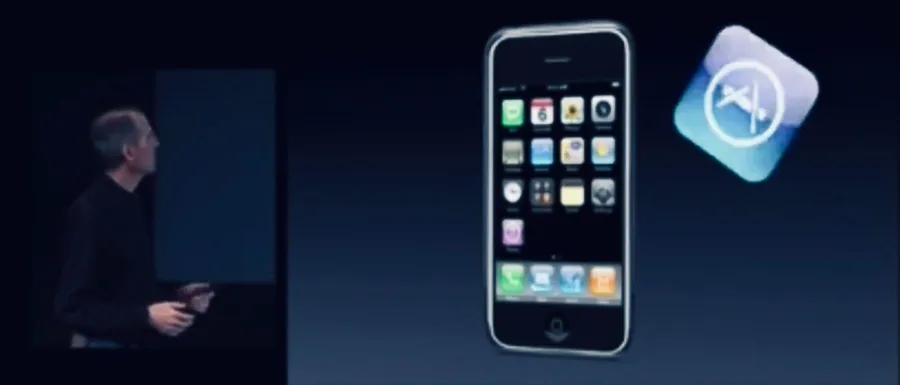
In July 2008, Apple launched the iPhone App Store with a business model that gave the telecoms a run for their money: developers would keep 70 percent of sales generated by their apps on the iPhone, while Apple would take 30 percent. If an app was free, Apple charged no commission. Jobs himself had initially resisted the idea of an App Store, worried about junk cluttering the iPhone experience, but with insistence from his executives, he came around before long. Thankfully so.
For a teenager in a dorm room building a free iPhone app, Apple thus provided the hosting, distribution, and platform without earning on each download. The developer still paid a flat $99 annual developer-program fee as well as any cost of making the app, but App Store’s proposition created an incentive structure for developers to aim big, because they had a chance at massive success. Think about this: even if a free iPhone app went viral and ten million people downloaded it over a weekend, its developer owed Apple nothing. If, after such success, the developer decided to start monetising the app, that’s when Apple’s 30 percent commission would kick in.
This was the foundational economic pact of the mobile era of consumer software: the developer (today’s “vibe coder”) ate first, always.
The playground this model created – “the iPhone Gold Rush” as NYT called it – yielded staggering results for everyone. In early 2009, a software engineer named Ethan Nicholas built an artillery game called iShoot. He first released a free “Lite” version of the game to promote it, which made the game wildly popular. Since that influx of massive traffic cost him nothing to host, he basically had the financial runway to let users fall in love with the game long before they bought the paid version. Nicholas made over $600,000 within a month and quit his corporate job. Within nine months of its launch, the game received over a billion downloads.
Apple, and later Google with Android, knew that to build a thriving, culture-defining ecosystem, they needed to own the distribution and lower the friction for consumer discovery. Their message to developers effectively was:
Come build on our land. We will pave the roads for you, install the power lines, create the water supply, and let people tour around for free. If you end up building something here that people are willing to pay for, only then will we take a cut. If you don’t, you’d have made our lands (the phones) more valuable anyway.
They weren’t being kind, of course. The fortune for Apple and Google came from selling phones, and every great app made their phones more desirable. It is a good example of “complement economics”: goods and services that together make the main product worth more over time. Smart platforms make their complements as cheap and frictionless to build as possible in interest of long-term success.
Similar alignment of incentives has shown up wherever a massive consumer wave has broken. It powered Facebook, which opened its platform to outside developers in 2007. Two brothers in Kolkata took advantage of it and built a Scrabble clone called Scrabulous which got more than half a million daily players. Reportedly, they were making $25,000 a month from advertising. Facebook’s platform economics allowed them to let consumers come first and figure out the business around it later. The same old consumer tech playbook.
These platform dynamics and incentive structures created a golden age of creativity and innovation, the two ingredients key to consumer culture. Developers could release unmonetised software as experiments – Zippo lighters, physics games, photo filters – and see what stuck. They didn’t have to ask consumers to open their wallets on day one, nor did they have to take out bank loans to run these experiments. This freedom to make and distribute new apps for consumers helped create an enormous consumer app economy that continues to thrive today in big billions – the kind of financial impact AI is yet to deliver.
We simply haven’t seen that kind of long-sightedness in the business models of frontier AI so far.
When a frontier lab like OpenAI, Google, or Anthropic offers an API to developers, it is strictly only selling usage of their models, not offering a partnership. In the pay-per-token model, there is no exception for “free apps”. The AI labs do not care if you are a company valued at two billion dollars or a little studio testing a cute driving game about an AI sister. Their meter runs the same way, making them similar to utility companies selling digital electricity by the kilowatt-hour.
It may be fair to say, thus, that in the “API economy”, the lab eats first. Always. Even if the developer goes hungry. I am not saying that is happening, but such is the nature of the business model.
If ten million people use your free AI chatbot app over a weekend, you may be celebrating a massive victory while also fielding a call from your bank about a six-figure bill (or raising a massive round of venture capital, if that’s your spiel). This is the second half of the structural problem. The API doesn’t just install a ticking meter, it inverts the risk profile. It forces developers to pay the platform before they find out if consumers will pay even a dime for their (AI) apps.
This is the overall shift in the economics of new technocapitalism. For Apple and Google, apps were complements that sold phones. An AI lab has no phone to sell. The model is the product, and the API toll is the business.
That makes the “builders” of this era more the target market, less the pathway to new consumer tech economies. The developers wiring up API keys today are customers before they can become harbingers of AI’s great consumer wave.
So What?
A system where “success” can threaten a startup’s survival will find it hard to cultivate the kind of sprawling, culture-defining consumer tech waves we have in the past. The next AI-native Instagram or WhatsApp is less likely to be built by a couple of kids stretching their budget on server space if a viral hit can drain their tokens within an afternoon.
How To Fix?
Until the AI companies at the frontier find a way to let developers eat first – most realistically by opening up their compute and platform infrastructure as smartphone app stores once did – the dream of a mainstream consumer AI revolution will remain distant.
The business model that could help AI become consumer AI – and consumer AI become consumer culture – is fairly obvious. Let developers sell on the frontier labs’ consumer platforms – that’s your chatgpt.com, gemini.google.com, claude.com, grok.com. Let consumers bring their existing AI plan to apps built on these platforms. Let developers offer free experiences without being billed on every AI interaction, and let the platforms earn when developers earn.
I believe the labs are already tinkering with this premise. Claude’s Artifacts and ChatGPT’s custom GPTs, plugins, shareable experience let people create AI-native experiences that others can use from their own AI accounts. But these products are highly limited by the capabilities and rules of their host platforms and don’t offer nearly the same room for creative, technical, and financial autonomy to developers that the app store business model did.
Apple, true to form, has already made a move in this direction. In 2025, it opened its on-device AI models to developers through its Foundation Models framework, saying that they can work “without cloud API costs”. These models are not a replacement for frontier cloud models as far as capabilities are concerned. But Apple still sells phones, and AI is today’s app store-level “complement”. Some early examples of developers innovating on Apple’s on-device model have already started showing up, as seen in Apple’s examples of apps using its Foundation Models framework.
Generosity As Business Strategy
In a rare interview about Apple’s App Store, Steve Jobs had said,
“Our purpose is to add value to the iPhone, and free apps do that just as well as paid apps. We love free apps. And by the way, some free apps have backend service complements.”
Generosity may in fact be the best long-term business strategy.
Jobs had to be talked into the idea of the App Store. It became one of the most valuable decisions in the history of not just Apple but technology in general, not because Apple built great apps, but because it let millions of creative, talented, and expressive people build them on its platform. The AI labs are where Apple was in 2007. Somebody needs to have the same conversation with them that Steve’s advisors did with him.